
The AEO Listing Blueprint: Why Every Real Estate Broker Needs an AI-Optimized Google Business Profile
 By Chrystal CaruthersFounder, AuthorityContent.aiPublisher, The Mortgage Note
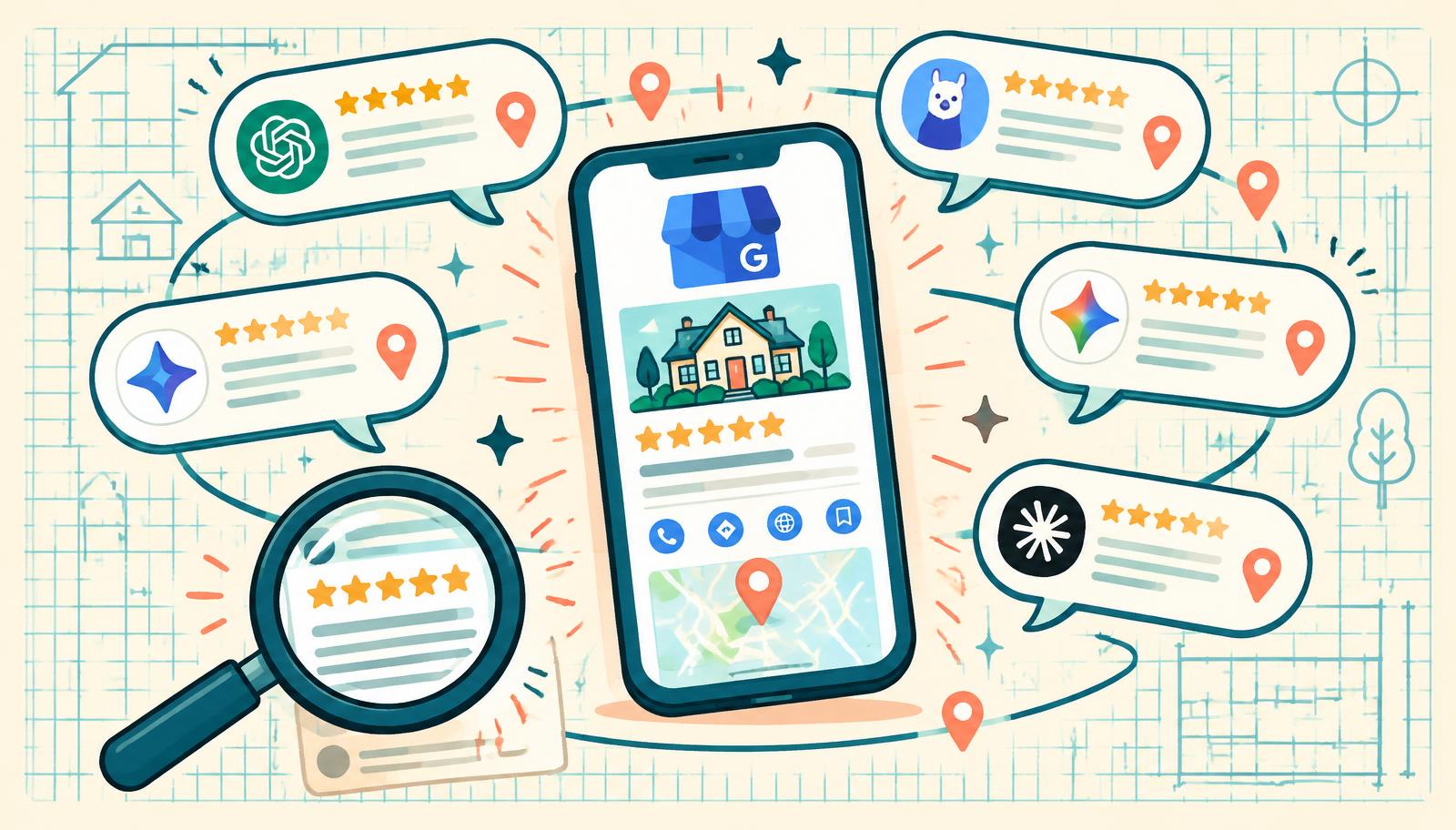
Buyers and sellers are asking ChatGPT, Gemini, and Perplexity who to hire — and the answer comes from your Google Business Profile. Here's the five-part blueprint to make sure it says your name.
TL;DR / Executive Brief
- AI engines answer 'who's the best agent near me' from your Google Business Profile — not your Instagram grid.
- Reviews, NAP consistency, service descriptions, and photo file names are the four data feeds AI reads first.
- Crossing 100 verified reviews moves your profile into Google's highest trust tier.
The old playbook is losing its punch
For decades, real estate marketing followed a predictable rhythm: pay thousands a month for portal impressions on Zillow and Realtor.com, blast property photos across Instagram, and send corporate-branded email newsletters. That playbook is rapidly losing its efficacy.
We have entered the era of Answer Engine Optimization (AEO). Affluent buyers and high-intent sellers no longer toggle rigid filters on legacy portals — they ask conversational AI engines like ChatGPT, Google Gemini, Perplexity, and Apple Intelligence nuanced, lifestyle-driven questions.
- “Which agent in the northwest suburbs specializes in high-acreage equestrian estates?”
- “Find a Barrington Hills real estate advisor with experience in custom new construction and private waterfront homes.”
- “Who is the most reputable luxury listing broker near me with proven negotiation results?”
When these queries hit a large language model, the engine doesn't sift through aesthetic Instagram grids. It extracts data from structured, open-source entity graphs — and at the center of your local entity graph sits the single most underutilized asset in real estate: your Google Business Profile.
1. Reviews are answer engine rocket fuel
The biggest misconception in reputation management is that client reviews exist solely for human validation. To an AI crawler, reviews are structured semantic proof.
“Heidi helped us navigate a complex purchase of an 8-acre estate in Barrington Hills with a custom outbuilding and pool...”
An AI engine ingests that review as verified, third-party confirmation of your exact geographic coverage, property specialties, and transaction competence.
Why review velocity dictates AI citations
AI engines prioritize fresh, living data. If your last Google review was published eight months ago, search algorithms downgrade your operational freshness score. To remain the definitive answer in conversational AI searches, brokers must establish review velocity — a continuous, automated stream of new client feedback.
2. The data split: why NAP consistency dictates your visibility
The second fatal mistake brokers make is treating their business identity like a social media handle. Many agents try to “hack” search algorithms by stuffing keywords and multiple company names into their Google profile title — for example, “Compass Jane Doe | Waterfront Specialist & Luxury Estates.” Google's algorithm severely penalizes this practice.
When your core Name, Address, and Phone Number (NAP) on Google fails to match your state licensing records, your MLS roster, and major portal directories, search scrapers interpret you as two or three distinct, conflicting entities. This splits your authority, strips your profile of review equity, and exposes your listing to competitor suspension flags.
Google's practitioner formula
Google enforces an exact, non-negotiable formula for independent real estate practitioners: “Jane Doe - Compass.” By standardizing your identity into this clean formula across every major portal and master data aggregator (such as Data Axle and Foursquare), you eliminate data fragmentation and force search bots to attribute 100% of your production and review authority to a single sovereign entity.
3. The 300-character hidden asset: semantic service engineering
Google policy strictly prohibits “real property” — houses and land — from being listed within its e-commerce Products tab. Most agents see this restriction and abandon profile customization altogether. Elite advisors, however, know how to leverage the Services menu.
Google permits businesses to append 300-character descriptive blocks to custom services. By stripping out generic marketing fluff and injecting high-density, localized keywords, brokers can feed AI scrapers the exact spatial and structural terms buyers search for:
- Luxury Property Advisory: specific mentions of high-acreage boundaries, waterfront assets, and multi-generational floorplans.
- New Construction Representation: hardcoding relationships with local custom builders, architectural firms, and zoning boards.
- Corporate & Executive Relocation: indexing regional school districts, executive housing corridors, and out-of-state transition support.
When an AI engine processes a conversational prompt, these 300-character semantic blocks provide the direct keyword matches needed to generate a confident citation.
4. Turning listing media into search assets (Vision AI)
Real estate is an inherently visual business, but search engines don't perceive photography the way human eyes do. They scan file structures, read metadata, and deploy computer vision models to verify geographic context.
When an agent uploads listing media titled IMG_4832.jpg or Kitchen_Edit.jpg, that visual asset contributes zero search value. A systematic AI-vision image naming formula transforms standard listing media into searchable data points:
- Bad — raw camera file: IMG_0482.jpg
- Good — optimized search asset: barrington-hills-luxury-ranch-inlaw-suite.jpg
Using lowercase text, hyphenated word separators, and strict factual asset descriptors, every photo uploaded to your Google profile actively anchors your geographic footprint and inventory specialties.
5. From manual hustle to automated infrastructure
Executing a complete AEO strategy cannot rely on manual effort. Top-producing brokers don't have the bandwidth to manually script keyword-dense review responses within 24 hours, re-engage cold database leads, or coordinate multi-platform citation syncs. Dominating the conversational AI landscape requires infrastructure and automation.
- Reputation automation: intelligent systems like Rave™ request reviews at transaction closing, generate AI review responses embedded with local geographic keywords, and syndicate 5-star proof across social channels automatically.
- Database reactivation: conversational AI platforms like Lazarus™ systematically re-engage dormant sphere contacts and stale inquiries, converting cold database contacts into booked consultations without manual cold outreach.
Want a professional to handle it for you? Book a 1:1 consultation with me, Chrystal Caruthers, and I'll optimize your Google Business Profile personally — done for you, start to finish.
Claim your digital equity
Your Google Business Profile is not a static business card. It is the primary data conduit between your real estate business and the generative AI engines shaping how affluent consumers find professional representation. Stop renting all your visibility from third-party advertising platforms. Standardize your entity graph, engineer your semantic services, automate your reputation velocity, and establish permanent search dominance in your market.
Frequently asked questions
Key takeaways
- Your Google Business Profile is the data source AI engines trust most for local agent recommendations.
- Fresh reviews are semantic proof — build a continuous, automated review stream.
- Standardize your name as “Your Name - Brokerage” everywhere to stop splitting your authority.
- Rename every listing photo with lowercase, hyphenated, factual descriptors.
Make AI say your name
Rave automates the review velocity this blueprint depends on — compliant asks at closing, keyword-rich replies, and 5-star proof syndicated across every channel AI reads.
See how Rave works