
Google Is the New Zillow: What Direct Listings Mean for Agents
 By Chrystal CaruthersFounder, AuthorityContent.aiPublisher, The Mortgage Note
Google now streams live MLS listings straight into search results, with call, message, and tour buttons attached. The portal era is ending, and the agents Google trusts are the ones getting the lead.
TL;DR / Executive Brief
- Google is no longer a funnel to portals — it is becoming the destination, with live MLS property cards and contact buttons inside search results.
- Brokerages withholding data from portals no longer risk obscurity, so buyers now need Google, portals, and an agent to see the whole market.
- Your Google Business Profile and review record decide which agent Google routes those high-intent leads to.
Google stopped being a map and became the destination
For twenty years, Google's job in real estate was to hand you off. You searched "homes for sale in Oak Park," Google sent you to a portal, and the portal sold your attention back to an agent. That handoff is being removed.
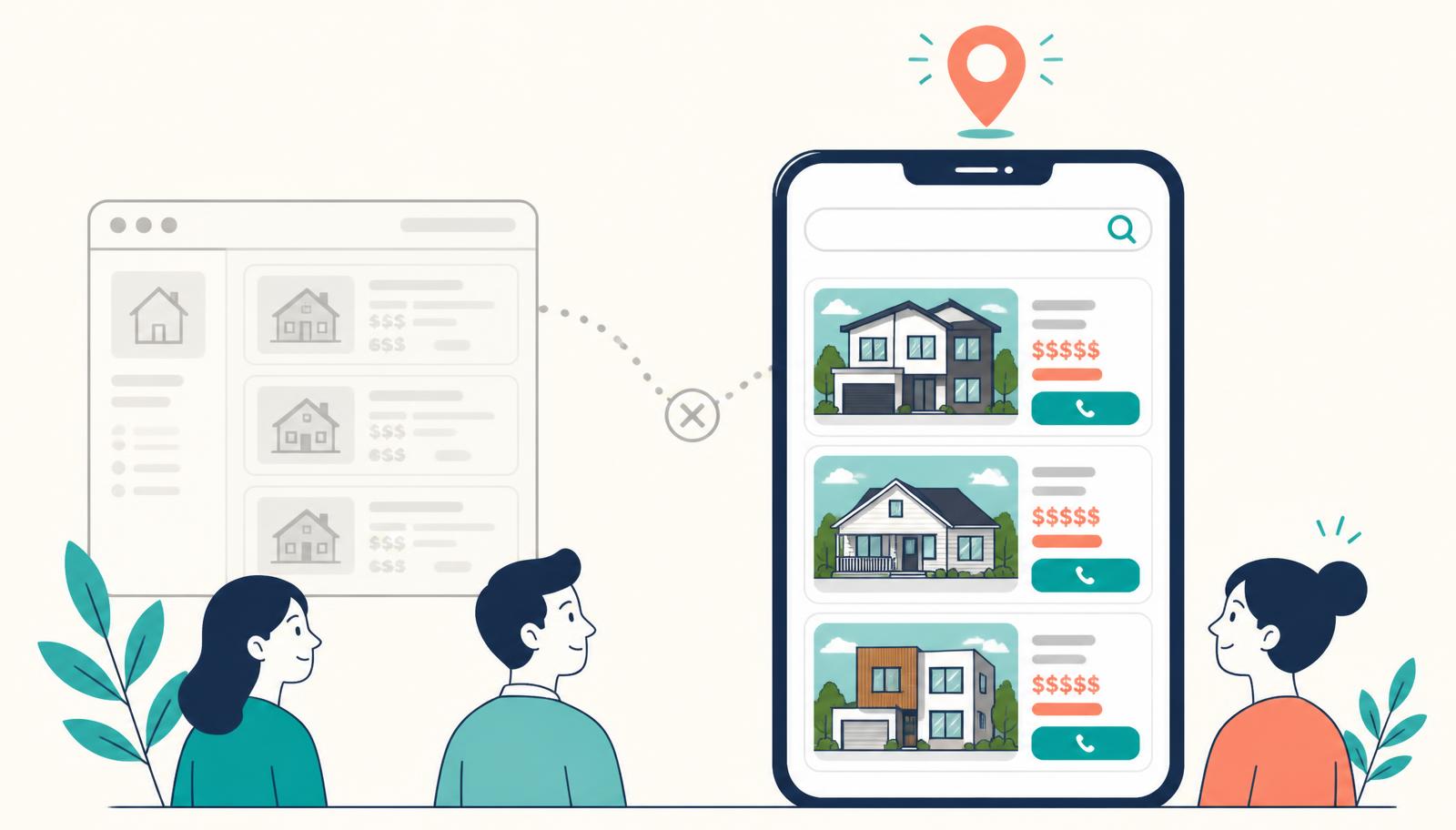
Google now streams verified, live listings from local MLSs — through its data partnership with HouseCanary — directly into the results page. Search on a phone and you get visual property cards at the very top: photo, price, address, square footage. Tap one and you can call, message, or book a showing without ever leaving Google.
The other half of the shift is conversational. Instead of filtering for "3 bed, 2 bath," buyers now ask Google's AI lifestyle questions — "neighborhoods near Chicago with a short commute and lower insurance costs." That dialogue happens on Google. The click that used to fund a portal never happens.
Google isn't competing for the click anymore. It's competing for the lead.
The listing war is fragmenting the market
The era of seeing 100% of homes on one app is over, and it isn't only Google's doing. Large brokerages have figured out that they can withhold data and survive.
- The Chicago blackout: a 2026 dispute cut Zillow off from roughly 43,000 listings through MRED, proving a portal feed can be switched off.
- Private exclusives: Compass has pushed listings shown only to its own agents and their buyers, keeping inventory off portals entirely.
- The "Zillow tax" argument: Compass released 2026 data claiming homes kept off Zillow sell for better prices.
Here's why that matters more now than it would have two years ago: a brokerage that pulls its data from a portal used to risk invisibility. With Google surfacing MLS listings directly, it doesn't. The leverage moved.
The funnel, before and after
- Old funnel: consumer search → Google → portal → agent lead.
- New funnel: consumer search → Google property cards fed by the MLS → agent lead.
Google monetizes the lead, not the click
Portals built a business on taking listing data, publishing it, and charging agents to buy back the leads it produced. Google is running the same model at a much larger scale.
Listings surface for free. When a buyer taps "Request a tour" or "Call agent," the local professional pays Google for that high-intent contact — routed through the Local Services Ads network. That is why brokerage ad budgets are quietly moving off portals and into Google.
How buyers will actually search now
No single source is complete anymore. Tell your clients the truth about the trade-offs — it makes you the guide instead of the app.
- Google AI search: best for neighborhoods, lifestyle fit, and ad-free first looks. Blind spot: private and coming-soon inventory locked inside brokerages.
- Portals like Zillow and Redfin: best for the bulk of active MLS listings and affordability tools. Blind spot: private exclusives and markets where a feed has been cut.
- A real agent: the only route to off-market and private-exclusive inventory. Blind spot: it takes a human, so it's slower than an instant search.
Why your Google profile is now your inside track
This is the part most agents skip. Google decides which agent gets shown next to a property card, and it makes that decision using signals it can verify — license, insurance, a passed background check, an answered phone, and reviews.
Reviews are how Google measures expertise and figures out who you actually serve. If your bio says twenty years in business, top producer, clients first — and your profile has twenty reviews — Google reads that as roughly one closing a year. To an algorithm that takes financial transactions seriously, a thin third-party record looks like a risk, not a referral.
Getting verified for Google's listing and lead program
- 1Start a Local Services Ads account using the same Google account that manages your Business Profile, and pick Real Estate Agent or Brokerage as your category.
- 2Set your service area by county, city, or zip, check both Buyer's Agent and Seller's Agent, and set a weekly budget — you only pay when someone calls or texts.
- 3Upload your active state license and a current general liability certificate, with names matching your Google account exactly.
- 4Clear the free third-party background check Google requires; it typically takes 3 to 10 business days.
- 5Connect your verified Google Business Profile so your existing reviews pull into your ads, and use the dashboard's review link with past clients.
- 6Add billing, wait for "Passed," then flip the account to active.
Then protect the status you just earned. Google tracks your answer rate — miss a call and your rank drops. But there's no need to work 24/7. Rave helps you optimize your Google reviews to ensure you're at the top of the Map Pack. Using AI, Rave works quietly in the background, sending surveys and review requests to happy clients to boost your standing. It also uses AI to reply to reviews because Google monitors review count, as well as, review responses. This is the new marketing strategy real estate agents in 2026 and beyond.
What to do this month
- 1Ask your managing broker one direct question: is our MLS currently syndicating our listings to Google, and are we set up to receive those leads?
- 2Search your own target zip codes on your phone and see whose listings and whose face appear on the property cards.
- 3Get your review count and recency to match the story your bio tells.
- 4Make sure your own site is machine-readable, so when Google's AI answers a question about your market it can cite you.
Frequently asked questions
Key takeaways
- Google now hosts live MLS listings with call, message, and tour buttons — the portal middleman is optional.
- Brokerages can withhold data from portals without going dark, so the market is fragmenting across Google, portals, and agents.
- Google charges for the lead, not the click, and routes it through Local Services Ads.
- Verification, an answered phone, and a fresh review record decide which agent gets shown.
- Use Rave to optimize your Google presence — more five-star reviews and AI-powered replies help you rank higher in the Map Pack and stay visible as search keeps changing.
Own your Google reputation
Rave builds the review record and AI-powered replies Google uses to decide who gets the lead. Get started today and turn past clients into your next rankings.
See how Rave works